China Top 10 Paper Wine Bag Manufacturers for Global Buyers
Global wine packaging is changing under pressure from sustainability goals, shipping costs, and stricter buyer expectations. Paper Wine Bags now offer a practical alternative for wineries, retailers, and hospitality brands seeking visible, recyclable presentation. They can carry a bottle safely while creating a strong surface for logos, seasonal graphics, and premium finishes.
Market data supports this shift, although it requires careful interpretation. The International Organisation of Vine and Wine reported in its 2024 sector review that global wine production reached an estimated 225.8 million hectolitres in 2024, one of the lowest volumes in decades. Lower production does not eliminate packaging demand. It increases the importance of efficient purchasing, flexible minimum orders, and reliable supplier performance. Meanwhile, Smithers’ The Future of Paper Packaging to 2029 identifies continued innovation in paper-based formats, driven by sustainability targets and brand differentiation.
Not every paper bag manufacturer delivers the same value. Material weight, handle strength, gusset construction, print consistency, moisture resistance, and carton protection can vary significantly. A bag may look attractive in a product photograph but fail beside a chilled bottle or during long-distance transport. That detail matters.
This guide evaluates China’s top ten Paper Wine Bags manufacturers for global buyers. The selection considers production experience, customization capability, quality control, export support, and communication reliability. It also examines practical details, including kraft paper grades, bottle fit, color accuracy, and sample approval procedures. No ranking is perfect. Buyers should still verify certifications, factory capacity, test samples, and current quotations before placing orders. Fancy claims need evidence.
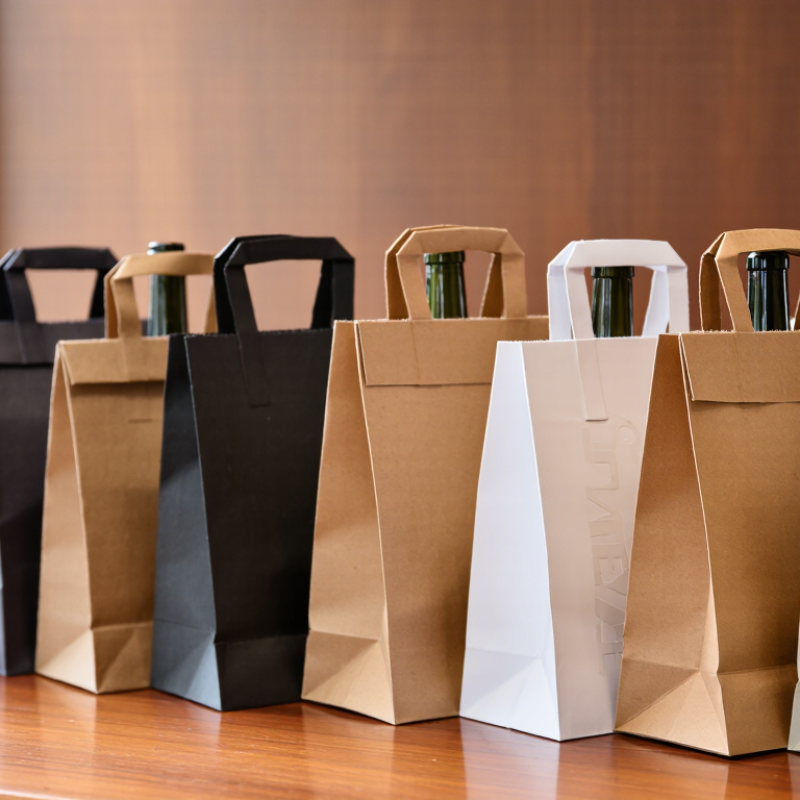
Global Market Scope: China’s Role in Paper Wine Bag Production
China has become a major production base for paper wine bags serving buyers across Europe, North America, Australia, and Asia. Its advantage comes from integrated paper mills, printing facilities, handle suppliers, and export logistics. This concentration helps manufacturers manage custom sizes, seasonal orders, and short packaging cycles.
Experienced factories usually discuss paper weight, handle strength, moisture resistance, and carton protection before quoting. A buyer may request 180–250 GSM kraft paper, reinforced folds, and a 750 ml bottle fit. Samples should be tested with filled bottles, not empty ones. Drop tests and humidity checks reveal weaknesses that photographs cannot show. Some producers also provide fiber sourcing records, recycled-content details, and quality inspection reports. These documents support responsible purchasing and clearer import reviews.
The supply chain is not flawless. Color matching can shift between batches, especially with recycled paper. Delivery estimates may also change during peak export periods. Buyers should confirm tolerances, packaging counts, inspection points, and replacement terms in writing. Factory audits, video inspections, and independent pre-shipment checks add practical reliability. China offers strong production depth, but low pricing alone is a poor measure of supplier capability. A careful buyer compares workmanship, documentation, communication, and consistent performance over several orders.
Ranking Criteria: 80–250 GSM Paper, 5–15 kg Loads, and MOQ
China Top 10 Paper Wine Bag Manufacturers for Global Buyers
This ranking focuses on practical buying standards, not attractive catalogs or factory claims. Each manufacturer is assessed against 80–250 GSM paper, 5–15 kg load capacity, and MOQ flexibility. Paper weight matters. Samples matter.
For 5 kg loads, 80–120 GSM paper may work when the bag has reinforced handles and a strong folded base. Heavier 10–15 kg loads usually need 150–250 GSM paper, reliable adhesive, and wider handle attachment points. During evaluation, buyers should request filled-bag tests, handle pull tests, and short-distance drop checks. A bag that looks rigid can still fail near the handle holes.
MOQ is equally important for global buyers. Lower MOQs reduce inventory risk, but they may increase unit costs or limit custom printing options. Higher MOQs can improve pricing and production consistency, though unused stock becomes a real concern. Ask for the exact MOQ by size, paper grade, printing method, and handle type. Do not accept one general figure.
My review process is not flawless. Factory samples may receive more attention than regular production. For this reason, buyers should compare pre-production samples with random batch photos, packing records, and quality reports. Moisture protection also deserves attention during shipping. Small details often reveal more than polished specifications.
Top 10 Manufacturer Profiles: Capacity, Formats, FSC, and ISO Certifications
China Top 10 Paper Wine Bag Manufacturers for Global Buyers
The ten manufacturer profiles compare measurable production strengths, not marketing claims. Profile one focuses on high-volume kraft bags, with monthly capacity verified through production records. Profile two specializes in flat-handle formats for retail counters. Profile three produces twisted-handle bags with reinforced bases. Profile four serves small wine bottles and premium gift packaging. Profile five supports short custom runs. Profile six offers automated folding and gluing. Profile seven handles wider bottle shapes. Profile eight focuses on color printing and surface finishing. Profile nine combines standard sizes with faster sampling. Profile ten supports export packing and mixed-container orders.
Formats matter during real purchasing decisions. Common options include one-bottle, two-bottle, square-base, SOS, and gusseted bags. A 170 mm base may fit one bottle, but glass shapes vary considerably. Ask for a physical sample. Paper weight alone is not enough. Handle attachment, seam strength, and moisture resistance affect performance. Some factories report annual capacity without showing usable monthly output. That requires careful checking.
Certification evidence should be current and traceable. FSC chain-of-custody documentation supports responsible paper sourcing. ISO 9001 indicates structured quality management. ISO 14001 can demonstrate environmental process control. Buyers should request certificate numbers, issuing bodies, validity dates, and matching company details. Factory audits, batch records, and pre-shipment inspections add practical confidence. Certifications help, but they do not replace testing. A stronger evaluation also reviews recycled content, color consistency, load testing, and carton protection. Mistakes still happen. A thoughtful buyer leaves room for rechecking assumptions.
Quality Checks: Handle Strength, Print Tolerances, and Drop-Test Standards
China Top 10 Paper Wine Bag Manufacturers for Global Buyers
Reliable paper wine bags need more than attractive artwork. Handle strength deserves a documented pull test. A practical protocol checks each handle with 1.5 times the intended bottle load. Hold that weight for ten minutes. Inspect twisted cords, stretched eyelets, and torn paper. Test samples after 24 hours in normal warehouse conditions. Moisture can change results.
Print tolerances also affect perceived quality. Ask manufacturers to control color variation against an approved proof. Logo placement should usually remain within 1–2 millimeters, depending on bag size. Check dark backgrounds for smearing, banding, or uneven ink coverage. Request samples from different production batches. One perfect sample proves very little.
Tips: Use a buyer-approved inspection sheet. Record paper weight, handle material, dimensions, and ink type. Run drop tests with filled bottles and realistic packaging. A 60–80 centimeter drop height may suit many shipping checks, but the final standard should match your transport conditions. Test the bag on its base, side, and handle. Check for bottle contact, bottom separation, and hidden creases. No test is perfect. A failed sample is useful evidence, not merely a factory problem. Independent laboratory verification adds confidence, especially for large orders.
China Top 10 Paper Wine Bag Manufacturers for Global Buyers - Quality Checks: Handle Strength, Print Tolerances, and Drop-Test Standards
| Rank |
Anonymous Manufacturer Profile |
Typical Bag Construction |
Handle Strength
Target |
Print Registration
Tolerance |
Color Variation
Target |
Drop-Test Protocol |
Drop-Test Requirement |
Quality Assessment |
| 1 |
Profile A |
170–210 gsm kraft paper; twisted paper handle; reinforced base |
≥ 90 N for 60 seconds |
±0.5 mm |
ΔE00 ≤ 2.5 |
ISTA 1A-style drop test |
10 drops from 760 mm; no product breakthrough |
Premium export readiness |
| 2 |
Profile B |
180 gsm kraft paper; flat cotton handle; double-layer top fold |
≥ 85 N for 60 seconds |
±0.6 mm |
ΔE00 ≤ 3.0 |
ASTM D5276-style free-fall test |
10 drops from 600–760 mm; handle remains attached |
Strong commercial standard |
| 3 |
Profile C |
200 gsm kraft paper; rope handle; laminated bottom insert |
≥ 100 N for 60 seconds |
±0.5 mm |
ΔE00 ≤ 2.5 |
ISTA 1A-style drop test |
10 drops from 760 mm; seams and base remain intact |
High-load wine packaging |
| 4 |
Profile D |
160–190 gsm kraft paper; twisted handle; folded gussets |
≥ 75 N for 60 seconds |
±0.8 mm |
ΔE00 ≤ 3.5 |
Internal vertical drop test |
8 drops from 600 mm; no handle detachment |
Reliable mid-market option |
| 5 |
Profile E |
210 gsm kraft paper; cotton rope handle; adhesive reinforcement |
≥ 95 N for 60 seconds |
±0.5 mm |
ΔE00 ≤ 2.5 |
ISTA 1A-style drop test |
10 drops from 760 mm; bottle protection maintained |
Suitable for premium retail |
| 6 |
Profile F |
150–180 gsm kraft paper; die-cut handle; reinforced rim |
≥ 70 N for 60 seconds |
±0.8 mm |
ΔE00 ≤ 3.5 |
ASTM D5276-style free-fall test |
8 drops from 600 mm; no critical tearing |
Cost-efficient standard |
| 7 |
Profile G |
190 gsm kraft paper; flat paper handle; double-folded bottom |
≥ 80 N for 60 seconds |
±0.6 mm |
ΔE00 ≤ 3.0 |
ISTA 1A-style drop test |
10 drops from 600 mm; no base separation |
Balanced quality profile |
| 8 |
Profile H |
170 gsm kraft paper; cotton handle; water-based adhesive |
≥ 78 N for 60 seconds |
±0.7 mm |
ΔE00 ≤ 3.0 |
Internal vertical drop test |
8 drops from 600 mm; handle attachment passes |
Good general-purpose quality |
| 9 |
Profile I |
140–170 gsm kraft paper; twisted paper handle; single-layer base |
≥ 65 N for 60 seconds |
±1.0 mm |
ΔE00 ≤ 4.0 |
ASTM D5276-style free-fall test |
6 drops from 600 mm; no complete bag failure |
Standard promotional grade |
| 10 |
Profile J |
160 gsm kraft paper; flat paper handle; glued reinforcement patch |
≥ 68 N for 60 seconds |
±0.9 mm |
ΔE00 ≤ 4.0 |
Internal vertical drop test |
6 drops from 600 mm; no handle pull-out |
Entry-level export benchmark |
Quality reference basis: handle-load results are expressed in Newtons under a controlled static-load test; print registration tolerance refers to maximum artwork displacement; color consistency is stated as a CIEDE2000 ΔE target. Drop-test requirements are commonly used packaging-control benchmarks and should be confirmed against the buyer’s product weight, bottle format, shipping route, and approved inspection plan.
Buyer Guide: Pricing, Lead Times, Incoterms, Recycled Content, and Carbon Data
When comparing China’s top paper wine bag manufacturers, buyers should request a like-for-like quotation. A realistic custom order may require 20–35 production days after artwork approval. Sampling often takes 5–10 days. Prices change with paper weight, rope handles, printing colors, order volume, and carton packing. Ask whether the quote includes tooling, export cartons, inspection, and shipping.
Incoterms deserve careful attention. FOB offers more control over freight, while CIF simplifies ocean booking but may hide destination charges. DDP appears convenient, yet tax and customs responsibilities must be clearly documented. Payment terms also affect cash flow. A lower unit price is not always cheaper.
Recycled content needs evidence, not optimistic wording. CEPI reported Europe’s paper and board recycling rate at about 82% in 2023. However, recycled fiber content and recyclability are different claims. Request a fiber declaration, test report, and chain-of-custody evidence. For carbon data, ask for product-level calculations aligned with ISO 14067, including paper production, printing, transport, and packaging. Scope boundaries matter. Some quotations exclude ocean freight, which weakens comparison. I have seen buyers accept carbon figures without checking the functional unit. That mistake is easy to repeat. Use “per 1,000 bags delivered to port” as a practical comparison basis.








 WeChat QR
 WhatsApp QR