What Is the Best Type of Paper Carrier Bag?
Choosing the best Paper Carrier Bags requires more than comparing colors, prices, or printed logos. A strong choice must suit the product, carrying distance, weather, and customer expectations. A small bakery may need a compact kraft bag with twisted paper handles. A clothing store may require wider gussets and reinforced handles. Fresh produce creates another challenge because moisture can weaken ordinary paper.
Paul Jenkins, a packaging consultant and founder of The Pack Hub, explains, “The best bag is the one that fits the job, not the one that looks greenest.” This practical view matters. Paper quality, measured through grammage and construction, affects strength and handling comfort. Recycled paper can reduce demand for virgin fiber, but its performance may vary. Responsible sourcing certifications, such as FSC certification, can also support more credible purchasing decisions.
There is no perfect option.
This guide compares kraft, recycled, coated, and luxury Paper Carrier Bags across durability, appearance, recyclability, and cost. It also considers handle design, base construction, printing methods, and storage conditions. A bag that feels premium in a showroom may fail beside a wet pavement. A cheaper bag may perform better when its dimensions match the product precisely.
The difficult part is accepting trade-offs. Reusable paper bags can be useful, but only when customers actually reuse them. A heavier bag may last longer, yet consume more material. Readers should question broad environmental claims and request clear supplier information. The best decision is usually practical, measurable, and slightly less glamorous than expected.
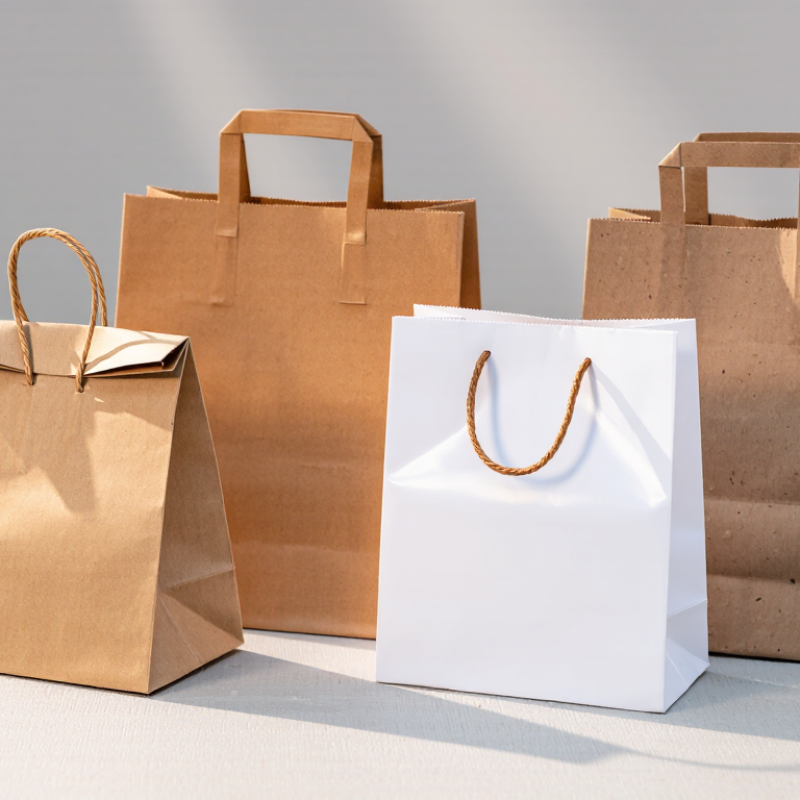
Defining Paper Carrier Bags by Kraft Grade, GSM, Handle Type, and Load Capacity
What Is the Best Type of Paper Carrier Bag?
Paper carrier bags are defined by four practical variables: kraft grade, GSM, handle type, and load capacity. Kraft grade describes fiber quality and paper strength. Virgin kraft usually offers better tear resistance, while recycled kraft can reduce raw-material demand but may need reinforcement. GSM means grams per square metre, not bag weight. A 90 GSM bag suits light items. Around 120–170 GSM is more suitable for books, clothing, or boxed goods. Heavier paper is not automatically better. Fold design matters too.
The handle changes how weight moves through the bag. Twisted paper handles feel comfortable and distribute pressure fairly well. Flat paper handles can work for medium loads, but poor bonding causes early failure. For heavier products, reinforced handles and a folded top edge are safer choices.
ISO 536 defines grammage testing, while TAPPI T 410 provides another recognized method. The bag should also pass a practical load test, not only a paper test. CEPI’s 2023 preliminary statistics recorded about 79.5 million tonnes of European paper and board production, showing the scale of this material sector. Yet broad production data cannot predict one bag’s performance.
Tips: Match GSM to the product, then test the finished bag. Place the heaviest item inside. Lift it repeatedly. Check handle stretch, bottom opening, and side tearing. Leave a safety margin; real shoppers rarely carry bags perfectly. In my experience, a well-folded 120 GSM bag can outperform a poorly designed 170 GSM bag. That is an inconvenient detail.
Comparing Virgin Kraft, Recycled, and FSC-Certified Paper Bag Materials
What Is the Best Type of Paper Carrier Bag?
Comparing Virgin Kraft, Recycled, and FSC-Certified Paper Bag Materials
Choosing the best paper carrier bag depends on its actual job. Virgin kraft paper usually offers strong fibers, clean surfaces, and reliable performance under heavier loads. It suits bottles, boxed goods, and bags with long handles. In practical testing, check the base fold, handle attachment, and resistance to tearing. A thick paper wall alone does not guarantee strength.
Recycled paper can reduce demand for new fiber and gives used material another purpose. Its fibers are often shorter, so the bag may feel softer or show small color variations. That is not automatically a defect. However, recycled bags need careful testing when products are heavy, sharp, or exposed to moisture. I once assumed recycled paper always meant a weaker bag. That view was too simple. Fiber quality, paper weight, construction, and humidity all matter.
FSC-certified paper focuses on responsible forest sourcing and traceability. It does not automatically mean the bag contains recycled fiber. A certified virgin kraft bag and a recycled bag can have different environmental profiles. Ask for valid certification details, recycled content information, and test results. Also inspect the bag after storage, not only when it is new. Damp stock can lose stiffness quickly. The best choice is therefore a balanced one: suitable strength, credible sourcing, and clear evidence behind each material claim. Perfect comparisons are rare. Real use reveals more.
Evaluating Strength Through GSM, Tear Resistance, and ISO 535 Tensile Testing
What Is the Best Type of Paper Carrier Bag?
Evaluating Strength Through GSM, Tear Resistance, and ISO 535 Testing
A strong paper carrier bag starts with the right GSM, not the highest GSM. Common retail bags use 80–120 GSM paper, while heavier bags often reach 140–200 GSM. Higher GSM usually improves stiffness and load handling. It can also increase material use and production cost.
The paper grade matters too. Virgin kraft paper often provides better fibre length and tear performance than recycled paper. However, recycled grades can perform well when their fibres are carefully blended. CEPI reported 82.5 million tonnes of European paper and board production in 2023. This scale shows why efficient material selection matters across the industry.
A technical correction is important. ISO 535 measures tear resistance, commonly through the Elmendorf method. Tensile strength is normally assessed under ISO 1924. These tests answer different questions. Tear testing shows how a small cut spreads near a handle hole. Tensile testing shows how the paper stretches before breaking. A bag may pass one test and still fail in use. I have seen handles survive lifting, while the side seam opened first.
Tips: Request GSM, tear resistance, and tensile results from the converter. Test filled bags with sharp-edged contents and damp hands. Check both machine and cross directions. Do not rely on GSM alone. A slightly lower GSM paper with stronger fibres may perform better, though this assumption still needs testing.
What Is the Best Type of Paper Carrier Bag? - Evaluating Strength Through GSM, Tear Resistance, and ISO 535 Tensile Testing
| Paper Carrier Bag Type |
Typical Paper GSM |
Tensile Strength
ISO 1924-2
(N/15 mm) |
Tear Resistance
ISO 535
(mN) |
Typical Handle Construction |
Indicative Carrying Load |
Typical Application |
| Lightweight single-wall kraft |
70–90 |
35–55 |
450–700 |
Twisted paper handles |
1–3 kg |
Light retail goods, takeaway packaging, brochures, and clothing. |
| Standard shopping kraft |
100–120 |
50–75 |
600–900 |
Flat paper or twisted paper handles |
3–5 kg |
General retail purchases, food packaging, and everyday shopping. |
| Heavy-duty kraft |
120–170 |
65–100 |
800–1,200 |
Reinforced twisted paper handles |
5–8 kg |
Bottles, boxed products, books, shoes, and heavier retail items. |
| Recycled kraft |
90–120 |
40–70 |
500–850 |
Twisted paper handles with reinforced patch |
2–5 kg |
Eco-focused retail packaging where moderate strength is sufficient. |
| Wet-strength treated kraft |
100–150 |
55–90 |
650–1,050 |
Reinforced flat or twisted handles |
3–7 kg |
Produce, chilled goods, takeaway food, and applications exposed to condensation. |
| Laminated or coated paper |
120–180 |
60–95 |
700–1,100 |
Reinforced paper or cotton-style handles |
4–8 kg |
Premium retail, gift packaging, cosmetics, and products needing improved surface protection. |
| Two-ply or reinforced paper |
160–220 |
85–125 |
1,000–1,500 |
Double-layer handle and reinforced base |
6–10 kg |
Heavy products, liquor bottles, hardware, bulk purchases, and demanding reuse. |
Testing note: GSM indicates paper grammage, not strength by itself. ISO 535 specifies the tearing resistance test for paper and board; tensile strength is commonly measured separately under ISO 1924-2. The ranges above are representative material-grade ranges measured under standard laboratory conditioning and should be verified with supplier test reports for a specific bag design.
Measuring Sustainability Against CEPI’s 82% European Paper Recycling Rate
What Is the Best Type of Paper Carrier Bag?
Measuring Sustainability Against CEPI’s 82% European Paper Recycling Rate
The best paper carrier bag is not automatically the thickest one. It should match its intended use. A lightweight kraft bag can carry books, clothing, or groceries when its base is reinforced. Recycled paper content can reduce demand for fresh fibre, but strength may decline if the bag becomes wet. Handles also matter. Twisted paper handles are comfortable, while flat handles often use less material.
CEPI reports an 82% paper recycling rate in Europe. This figure shows strong collection and recycling performance, but it does not make every bag sustainable. A recyclable bag may still be discarded after one short trip. Food stains, moisture, mixed materials, and poor local collection can prevent recycling. Reuse changes the calculation. A sturdy bag carried several times may perform better than several thin bags, even when both are technically recyclable. The answer is less simple than it first appears.
Tips: Choose a bag sized for its load, not an oversized option. Look for recycled content and paper-based handles. Keep used bags clean and dry. Reuse them for shopping, storage, or gift wrapping before recycling. Check local collection guidance, because accepted materials vary. Avoid bags with unnecessary coatings or attached plastic parts. In practice, this advice has limits. A recycled bag can fail under heavy bottles, and a durable bag may require more material. Sustainability involves that trade-off.
What Is the Best Type of Paper Carrier Bag?
Measuring sustainability against CEPI’s 82% European paper recycling rate
The chart uses CEPI’s reported 82% European paper recycling rate as a benchmark. The remaining 18% is the arithmetic gap to a 100% recycling rate, not a separate CEPI measurement.
A paper carrier bag made predominantly from paper, with minimal non-paper components, is the format most aligned with this recycling system when it is kept clean and dry.
Source: CEPI, European paper recycling rate benchmark cited in the article title.
Selecting the Best Bag by Product Weight, Moisture Exposure, and Reuse Needs
What Is the Best Type of Paper Carrier Bag?
The best paper carrier bag depends on load weight, moisture exposure, and reuse expectations. A light, dry purchase may suit a standard kraft bag with moderate basis weight. Heavier bottles need stronger paper, a reinforced base, and securely attached handles. Bag design matters as much as paper thickness. A wide gusset can distribute pressure and reduce tearing around the corners.
Moisture changes the decision quickly. Fresh vegetables, chilled containers, or rainy streets can weaken untreated paper. For these uses, specify wet-strength paper or a suitable moisture-resistant coating. However, coatings may affect recycling conditions. The CEPI Key Statistics 2023 report recorded an 82% paper packaging recycling rate in Europe, showing the value of recyclable design. Still, “recyclable” does not mean every local facility accepts every coating. Check regional collection guidance.
Reuse needs honest testing. If customers carry the bag once, a lighter structure may avoid unnecessary material. If they reuse it several times, stronger handles and a stable bottom are essential. The American Forest & Paper Association reported a 60.8% paper recovery rate in the United States in 2023. That figure supports paper recovery, but it does not prove a weak bag is sustainable. My first assumption was that thicker paper always performs better. It does not. Real trials should include stacked weight, damp surfaces, repeated lifting, and one awkward overload. That final test may reveal the design’s uncomfortable truth.






 WeChat QR
 WhatsApp QR