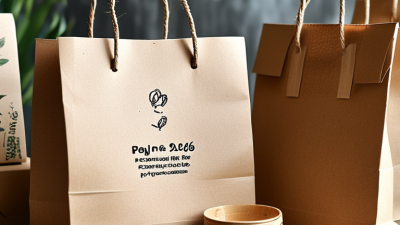
China’s paper packaging sector is gaining attention from wholesale buyers seeking practical, branded alternatives to plastic shopping bags. Grand View Research estimated the global paper bags market at approximately USD 5.4 billion in 2022. It also projected a compound annual growth rate of about 4.9% from 2023 to 2030. Smithers reports continued demand for recyclable and fiber-based packaging, especially in retail and food service. Market growth looks promising. It is not automatic.
For buyers, Paper Gift Bags must balance appearance, strength, customization, and landed cost. A 250–300 gsm kraft bag may support boutiques, cosmetics, and event merchandise. Reinforced handles matter. So does a flat, clean base. One weak fold can damage a premium brand image. Chinese manufacturers often provide offset printing, hot stamping, rope handles, twisted paper handles, and custom dimensions. However, recycled content, ink selection, coating type, and factory quality controls require careful verification. “Waste equals food,” sustainability expert William McDonough famously stated. His principle encourages buyers to consider the bag’s next use, not only its first impression.
A reliable wholesale supplier should share material specifications, production samples, inspection procedures, and realistic lead times. Buyers should request testing before placing large orders. Paper is renewable, but every paper bag still consumes resources. That detail deserves honest discussion. The best China Paper Gift Bags manufacturer is not simply the cheapest supplier. It is the partner that delivers consistent quality, transparent documentation, and practical design support at scale.

Paper gift bags combine presentation, protection, and practical handling. Common materials include kraft paper, coated paper, and recycled paper. Kraft paper offers a natural texture and reliable strength. Coated paper creates sharper colors and a smoother surface. Recycled grades support sustainability goals, although their texture may vary slightly.
Paper weight matters. Lightweight bags suit small gifts, cards, and promotional items. Heavier paper supports bottles, books, and boxed products.
Popular formats include square bags, tall wine bags, flat-bottom bags, and gusseted shopping bags. Each shape affects storage, loading speed, and shipping volume. Small details matter.
Handle choices include twisted paper, flat paper, cotton rope, and die-cut handles. Twisted paper handles provide a balanced, economical option. Rope handles feel more decorative but may increase packing costs. Die-cut handles save material, yet they can reduce comfort with heavier contents. A strong appearance does not guarantee comfortable use.
For wholesale buyers, paper gift bags serve retail stores, events, bakeries, clothing shops, and seasonal campaigns. Order specifications should cover size, paper weight, handle attachment, printing method, and carton packing. Sampling remains essential. Colors can shift between digital artwork and printed bags. I would not approve large production from artwork alone. Check handle strength, folded edges, base construction, and odor before shipment. Some recycled paper bags look excellent, but inconsistent fibers may affect premium presentation. That trade-off deserves an honest review.

China Best Paper Gift Bags Manufacturer for Wholesale Buyers
China produced 129.65 million tonnes of paper and paperboard in 2023, according to the China Paper Association. Domestic consumption reached 131.65 million tonnes. This scale suggests strong material availability for wholesale gift bag production. It does not guarantee consistent quality. Output volume is only one part of the purchasing decision.
For buyers, the useful questions are more specific. What paper weight is available? Is the handle firmly attached? Can the bag survive a 5-kilogram load test? China Customs trade statistics also show active movement in paper and paperboard products during 2023. That supports export capability, but packaging details still need verification. Request pre-production samples, compression tests, and measurable dimensions. Small differences matter.
Recycled paper can support sustainability goals, yet its surface may feel less smooth. Coated paper prints sharply, but coating choices can affect recyclability. This trade-off deserves an honest discussion. A practical supplier should provide paper specifications, tolerance ranges, packing details, and inspection records. Buyers should also check whether quoted capacity covers peak seasons. Large national output can hide factory-level limits. Sometimes, the cheapest quotation becomes expensive after weak handles, uneven folding, or delayed shipment. So, review samples carefully. Mistakes happen. Good sourcing leaves room to catch them early.
Wholesale buyers should examine MOQ before comparing prices. A practical factory may offer 500 to 1,000 bags for standard sizes. Custom handles, foil printing, or unusual paper can increase the minimum order. Ask whether the MOQ applies per design, color, or total shipment.
Ask whether the MOQ applies per design, color, or total shipment.
Request monthly production figures, available machines, and recent lead times. A factory producing 300,000 bags monthly may still struggle during holiday seasons. Ask for a sample production schedule. It should show printing, cutting, assembly, inspection, and packing dates. Small details matter.
Pricing should include paper weight, dimensions, handle material, printing colors, packaging, and delivery terms. A low quotation may exclude inner cartons or export packing. That mistake can damage your budget.
Export data can reveal useful patterns, including shipment frequency, destination regions, and product descriptions. Request redacted shipping records or customs documents when possible. Verify the company’s business license and factory address through independent sources.
I have learned that polished samples do not prove stable mass production.
Ask for a pilot order and inspect random cartons. Some buyers focus too heavily on unit price. That is understandable, but incomplete. A dependable supplier communicates delays early, records quality checks, and explains defects honestly.
Still, no factory is perfect; buyers should define acceptable tolerances before signing production terms.
Wholesale paper gift bags require more than attractive printing and a strong handle. Consistent quality protects packing schedules, retail presentation, and buyer confidence.
Our inspection teams use ISO 2859-1 sampling plans for production lots. The method considers lot size, inspection level, and the selected AQL. AQL 1.5 and AQL 2.5 are acceptance quality limits, not promises of zero defects. The sampling table sets the sample quantity and acceptance or rejection numbers.
We check paper weight, dimensions, handle attachment, folding accuracy, glue coverage, and print alignment. A practical inspection may include cartons from different pallet positions, not only the easiest cartons to reach. Each sampled bag receives a visual review, while selected handles undergo pull testing. Moisture, crushed corners, and uneven bottoms also need attention during warehouse inspection.
Small details matter.
Records should show the lot number, sample size, defect classification, and inspector’s decision. Major defects may affect safe use or appearance, while minor defects usually have limited impact. The exact classification must be agreed before production begins. An inspection plan can still miss a rare problem. We have seen acceptable samples hide inconsistent handle bonding in unsampled cartons. That weakness deserves review, not denial. Buyers should request corrective-action records, retain sample photos, and compare results across shipments. Clear evidence makes supplier performance easier to evaluate.
China Best Paper Gift Bags Manufacturer for Wholesale Buyers
Wholesale buyers need more than attractive paper gift bags. They need traceable materials and reliable compliance evidence. A responsible Chinese manufacturer should explain its FSC Chain of Custody process clearly. This includes certified fiber purchasing, controlled production, separated storage, and documented sales records. Ask for the certificate scope and validity. A logo alone proves little.
EN 13432 requires careful product evaluation. It covers industrially compostable packaging, including biodegradation, disintegration, ecotoxicity, and restricted substances. The paper body may pass, while coatings, inks, adhesives, or handles create problems. This detail is often missed. Request current laboratory reports for the finished bag, not only its raw paper. Confirm whether testing matches the actual size, printing, and accessories.
Production experience also matters. During factory checks, inspect labeled material stacks, batch records, and sample retention. Ask how rejected materials are controlled. Small gaps can damage a large shipment. No process is perfect. A supplier should admit these risks and show corrective actions. Buyers should also confirm whether EN 13432 claims apply to industrial composting only. They should avoid implying home compostability without separate evidence. Reliable documentation, consistent sampling, and transparent communication create stronger purchasing decisions.
| Compliance Dimension | Applicable Requirement | Key Verified Data or Threshold | Documents to Request | Wholesale Buyer Action |
|---|---|---|---|---|
| Forest-Fibre Origin | FSC Chain of Custody (CoC), FSC-STD-40-004 | Paper and wood-based inputs must be controlled through the certified supply chain when an FSC claim is made. | Valid FSC certificate code, certificate scope, product-group scope, and certification status. | Check the certificate in the official FSC certificate database before approving the supplier. |
| FSC Claim on Sales Documents | The FSC claim must correspond to the certified product and appear on relevant sales or delivery documents. | Typical FSC claims include FSC 100%, FSC Mix, or FSC Recycled, subject to the certificate scope and applicable FSC rules. | Commercial invoice, delivery note, product specification, and FSC claim wording. | Match the claim, product description, quantity, and certificate scope across all documents. |
| Material Traceability | FSC CoC requires documented control of certified material through purchasing, production, storage, sales, and record keeping. | Traceability should cover incoming paper, production batches, finished bags, and outgoing sales records. | Batch records, purchase records, stock-control procedure, production records, and shipment records. | Require batch-level documentation for large-volume or multi-country purchasing programs. |
| Product Composition | Paper gift bags may include paper, water-based or other coatings, inks, adhesives, handles, eyelets, and accessories. | Every component should be identified by material, weight or percentage where relevant, and intended end-of-life route. | Material declaration, bill of materials, ink and adhesive declarations, and coating specification. | Review the complete construction rather than assessing the paper substrate alone. |
| Compostability Standard | EN 13432:2000, “Requirements for packaging recoverable through composting and biodegradation.” | The assessment applies to the packaging and its organic components under the standard’s laboratory conditions. | Test report or conformity documentation identifying the exact material and construction tested. | Confirm that the tested sample is identical to the production specification, including inks, handles, coatings, and adhesives. |
| Biodegradation | EN 13432 requires biodegradation of the organic components under controlled composting conditions. | At least 90% biodegradation within a maximum of 6 months, measured against an appropriate reference material or by the applicable absolute criterion. | Biodegradation test report, test method, reference material, test duration, and result. | Do not accept a general “biodegradable” statement without a standard-specific test result. |
| Disintegration | Packaging must physically disintegrate during industrial composting without leaving unacceptable visible residues. | At least 90% of the original dry mass should pass through a 2 mm sieve after a maximum test period of 12 weeks. | Disintegration test report stating sieve size, test period, sample preparation, and percentage result. | Check whether non-paper components were included in the tested sample and whether they meet the same requirement. |
| Ecotoxicity | Compost produced after testing must not show adverse effects on plants under the applicable assessment procedure. | Plant-growth testing is used to assess the quality and potential toxicity of the resulting compost. | Ecotoxicity or plant-response test report, including control comparison and test conditions. | Request test evidence for printed and coated versions, not only for unprinted paper. |
| Heavy Metals and Fluorinated Substances | EN 13432 includes restrictions on heavy metals and other substances that may negatively affect compost quality. | The tested packaging must comply with the standard’s substance limits and assessment criteria. | Laboratory analysis for relevant heavy metals and supplier declaration regarding intentionally added fluorinated substances. | Specify restrictions for inks, coatings, grease barriers, and handle treatments in the purchase contract. |
| Industrial Composting Route | EN 13432 addresses controlled composting conditions and does not automatically mean home compostability or marine biodegradability. | A product can meet industrial-composting criteria while requiring collection by a suitable commercial composting facility. | Disposal guidance, certification scope, and applicable local collection instructions. | Use precise wording such as “industrially compostable” unless home-compostability evidence is separately available. |
| Artwork and Production Change Control | A change in paper grade, coating, ink, adhesive, handle, or finishing process can affect compliance evidence. | The production version should remain within the formulation and construction covered by the submitted test report. | Approved artwork, signed specification, change-control record, and updated test evidence when materials change. | Require written approval before any material substitution or finishing change during repeat orders. |