How to Choose Paper Party Bags for Wholesale Buyers?
Choosing Paper Party Bags for wholesale resale requires more than comparing unit prices. Buyers must assess paper weight, handle strength, printing quality, sourcing, and carton efficiency. A bag may look attractive online, yet tear when filled with small toys, candles, or boxed sweets.
Market evidence supports careful selection. Smithers’ The Future of Sustainable Packaging to 2028 reports that the global sustainable packaging market is expected to reach approximately US$423.56 billion by 2028. Grand View Research also identifies steady growth in the global paper bags market, driven partly by retail packaging changes and consumer preference for recyclable materials. These figures show opportunity, but they do not guarantee product performance.
Real-world testing matters.
Forest certification deserves attention. Kim Carstensen, former Director General of the Forest Stewardship Council, said, “We need to use forests, but we need to use them responsibly.” His point applies directly to Paper Party Bags: ask suppliers for credible FSC documentation, recycled-content details, and traceable material information. Avoid accepting vague claims such as “eco-friendly” without evidence.
Wholesale buyers should compare GSM, bag dimensions, gusset depth, handle attachment, moisture resistance, and print durability. Request samples first. Fill them with realistic products, then lift and store them for several days. Some assumptions may fail. Thicker paper is not always stronger, and recycled fibers can affect stiffness or print appearance.
A reliable supplier should provide pre-shipment inspection, consistent batch quality, clear packaging specifications, and transparent lead times. The best purchasing decision balances appearance, strength, sustainability, and total landed cost. Cheap bags can become expensive when returns, damaged goods, or missed seasonal sales follow.
What Are Paper Party Bags and Why Do Wholesale Buyers Choose Them?
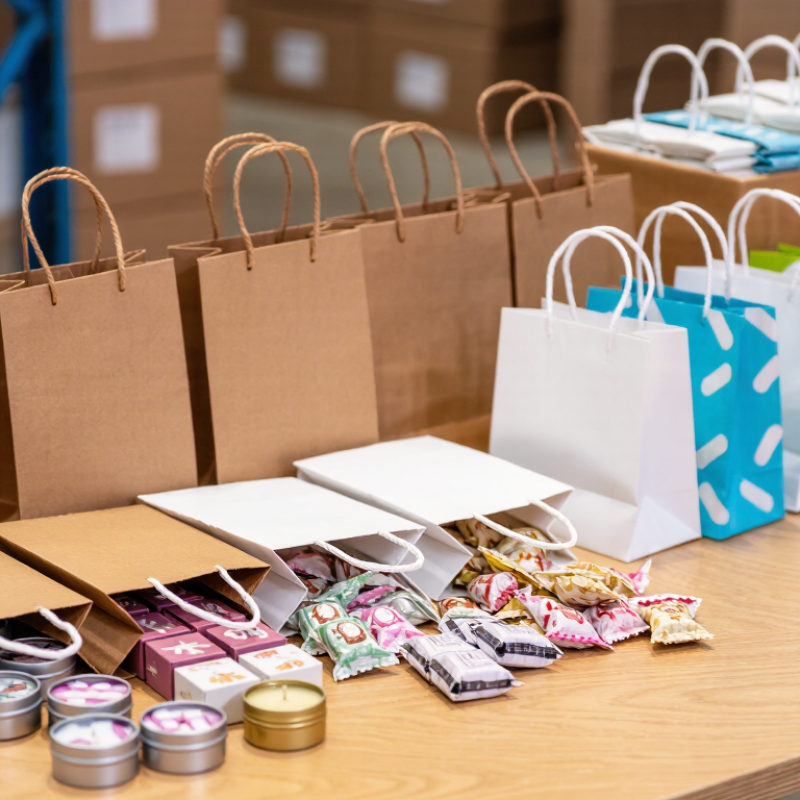
Paper party bags are lightweight carry bags made mainly from kraft paper. They often include folded gussets, flat bottoms, and twisted paper handles. For wholesale buyers, the appeal is practical: flat storage, simple decoration, and easy size grouping. Small details matter.
CEPI’s 2023 recycling statistics reported a 79.3% paper recycling rate in Europe, indicating strong recovery infrastructure. That figure covers paper overall, not every party bag. Buyers should check basis weight, handle strength, bottom construction, print coverage, and moisture resistance before approving samples. An overloaded bag can split at the fold. The U.S. Environmental Protection Agency recorded 46.9 million tons of paper and paperboard containers and packaging recycled in 2018. This supports paper’s recovery potential, but coatings and mixed handles can complicate sorting. Wholesale selection is not automatically sustainable. That is the uncomfortable part.
Choose bags with consistent dimensions, documented recycled content, and protective outer packaging. Warehouse humidity can soften untreated paper. A neutral kraft color can serve birthdays, weddings, and retail gifting. Custom printing improves recognition, but heavy ink coverage may affect recovery. Request a pre-production sample. Test it with the real product, not an empty display piece. Cost still leads many decisions, and that is understandable. Yet a stronger bag may reduce returns, repacking, and customer complaints. Paper party bags balance presentation, logistics, and material familiarity, but each claim needs verification.
How to Choose Paper Party Bags for Wholesale Buyers?
Paper party bags are disposable or reusable shopping-style bags made from paper, commonly used for party favors, gifts, candy, and small retail items. Paper weight, measured in GSM (grams per square metre), is an important wholesale buying factor because it affects durability, appearance, and cost.
The chart shows typical paper-weight ranges used for different party-bag applications. Lightweight bags are suitable for small favors, while higher-GSM bags are more appropriate for heavier gifts and premium presentation. Actual load capacity also depends on bag size, paper quality, handle construction, and the strength of the bottom fold.
Which Paper Types, Sizes, and Styles Fit Your Party Bag Needs?
Choosing paper party bags starts with the product, not the decoration.
Kraft paper suits rustic events and hides minor scuffs. White paper gives sharper colors and a cleaner retail appearance. Recycled fiber adds a natural texture, but shade variation can occur. That is worth checking before approving large volumes.
For small favors, 120–160 mm bags usually work well. Bottles, candles, or boxed gifts may need 180–260 mm widths and a gusset. Select paper around 100–170 gsm for ordinary favors. Heavier contents need reinforced bases, stronger handles, or thicker paper. Twisted paper handles feel comfortable, while flat handles reduce cost and storage space. Test the handle. A sample filled with the real item reveals weak folds, loose adhesive, and awkward proportions.
Style should follow the buying occasion. Die-cut windows display sweets, but they reduce privacy and may weaken the front panel. Matte finishes feel understated, while coatings can complicate recycling.
CEPI’s 2023 Monitoring Report recorded a 79.3% paper recycling rate in Europe, supporting fiber-based choices, but mixed materials still require careful evaluation.
The U.S. Environmental Protection Agency reported roughly 80% recovery for paper and paperboard packaging in its detailed national dataset.
These figures do not guarantee local recyclability. Check the destination market’s collection system. I would not trust a printed specification alone. Small details matter.
How Should You Evaluate Quality, Printing, Handles, and Durability?
Wholesale buyers should assess paper party bags as working packaging, not just attractive samples. Check the paper weight, fiber consistency, and fold accuracy. A bag with uneven sides may look acceptable on a product sheet but fail during packing. Press the base gently and inspect every glued seam. Small gaps often become large tears.
Printing quality needs practical testing. Request a physical proof before approving bulk production. Compare colors under daylight, because indoor lighting can hide weak contrast. Rub the printed surface with a dry white cloth. Ink transfer suggests poor curing or unsuitable materials. Alignment matters too. A slightly misplaced pattern can make a premium design look careless. I once focused too much on color accuracy and overlooked rough edges around the handles.
Handles deserve separate attention. Pull them repeatedly with a realistic load, then test the reinforced patches inside the bag. Twisted paper handles can feel comfortable, while flat handles may offer better stability for wider bags. Do not trust one successful sample. Test several bags from different cartons. For durability, fill bags with the intended products and leave them overnight. Add a short carrying test across different surfaces. Humidity can soften paper unexpectedly. That detail is easy to miss. Record failures honestly, because a lower-cost bag is not economical if customers return damaged orders.
What Quantity, Pricing, and Customization Options Should You Compare?
Wholesale paper party bags should be compared by usable cost, not unit price alone. Ask suppliers for prices at three quantities, such as 1,000, 5,000, and 20,000 pieces. Include printing plates, sampling, freight, and defective units. Smithers’ sustainable packaging forecast projects the market to grow from about $272 billion in 2023 to nearly $394 billion by 2028. That growth may improve production capacity, but small orders can still carry high setup costs.
Check bag size, paper weight, handle strength, and carton efficiency. A 170 mm bag may suit small gifts, while a 250 mm version handles boxed items better. Compare the landed cost per usable bag. Request a tolerance sheet for dimensions and print alignment. Customization can include kraft or white paper, matte or gloss coating, twisted handles, rope handles, and two-sided printing. More options create more sampling risk. I would not assume every recycled-paper claim means identical performance. Verify the recycled content, coating type, and test method.
Tips: Compare the same specification across every quotation. Record minimum order quantity, production time, payment terms, and replacement policy. Ask for a pre-production sample. A cheaper bag with weak handles can increase customer complaints. Also review color consistency between batches. It is easy to overlook. The Flexible Packaging Association’s consumer research shows packaging appearance strongly affects purchase decisions, so print quality deserves a real budget. Test one filled bag overnight before approving bulk production.
How Can You Select a Reliable Paper Party Bag Supplier?
How to Choose Paper Party Bags for Wholesale Buyers?
A reliable paper party bag supplier should offer more than attractive samples. Ask about paper weight, bag dimensions, handle strength, and printing consistency. For busy retail seasons, confirm production capacity and realistic lead times before placing a large order. Request a physical sample, then inspect its seams, folded edges, and handle attachment. Fill it with ordinary products to test its balance. Small details matter.
Tips: Ask for material specifications, quality-control records, and clear approval procedures. Compare the approved sample with the first production batch. Keep written records of colors, sizes, packing methods, and delivery dates. A supplier who answers quickly is helpful, but fast replies do not always prove reliable performance.
I have found that transparent suppliers usually explain their process without avoiding difficult questions. They should identify who checks raw materials, when inspections happen, and how defective bags are handled. Check whether cartons protect the bags from crushing and moisture during storage. Discuss minimum order quantities and repeat-order flexibility, too. A polished sample can still hide weak production control. That is easy to miss.
Buyers should review supplier performance after every shipment, not only after problems appear. A simple scorecard can track quality, communication, timing, and response to corrections. No supplier is perfect, and honest discussion often reveals more than impressive promises.



 WeChat QR
 WhatsApp QR